Why word-level tokenizers break
July 16, 2026 · 6 min read
A language model never sees your text. It sees a list of integers. Before any attention
or matrix multiply happens, something has to turn "Shall I hear more" into
[8761, 5032, 4705, 6430] and back again. That something is the tokenizer, and its whole
job is two functions:
encode(text) -> [ids]- text to a list of integer idsdecode([ids]) -> text- ids back to text
It is tempting to read that pair as a lossless round-trip, where decode(encode(x)) returns
x. It usually isn't. A tokenizer first normalizes text - it may lowercase, drop
punctuation, or collapse whitespace - and only then assigns ids. So decode(encode(x))
returns a normalized version of x, not x itself. How much gets lost in that
normalization, and why, is the whole subject of this post.
The simplest tokenizer that satisfies the contract
To make the loss concrete we need the smallest thing that actually implements encode and
decode. The design is deliberately minimal:
- Word-level. A token is a whole word. This keeps the vocabulary human-readable and the code short - you can see exactly what every id stands for.
- Lowercased. One less axis of variation, so
Shallandshalldon't consume two separate ids. - Trained on tiny-shakespeare - the ~1 MB single-file Shakespeare corpus from Karpathy's char-rnn. Small enough to inspect by hand, real enough to behave like language.
"Training" here is not gradient descent - it is just collecting the vocabulary. The tokenizer walks the corpus once, and the sorted set of words it sees becomes the vocabulary, plus two special tokens:
import re
from typing import List


class SimpleTokenizer:
    """Word-level tokenizer: lowercases, splits on whitespace/punctuation, maps to integer ids."""

    # Punctuation is used as a delimiter (not kept as a token), text is lowercased,
    # and the Shakespeare-specific "&c" abbreviation is stripped.
    SPLIT_RE = re.compile(r"[ \n.'!,:;?\-]")

    def __init__(self, text: str):
        tokens = self._tokenize(text)
        vocab = sorted(set(tokens)) + ["<|unk|>", "<|endoftext|>"]
        self.token_to_id = {t: i for i, t in enumerate(vocab)}
        self.id_to_token = {i: t for t, i in self.token_to_id.items()}

    def _tokenize(self, text: str) -> List[str]:
        cleaned = re.sub(r"&c", "", text.lower())
        return [t for t in self.SPLIT_RE.split(cleaned) if t]
Every normalization decision lives in _tokenize: lowercase, strip the &c abbreviation,
then split on punctuation and whitespace. Splitting on those characters means they act as
separators and are thrown away - a choice that comes back to bite us shortly.
With the vocabulary fixed, the contract itself is four lines. encode looks each token up;
anything not in the vocabulary falls back to <|unk|>. decode reverses the map:
    def encode(self, text: str) -> List[int]:
        unk = self.token_to_id["<|unk|>"]
        return [self.token_to_id.get(t, unk) for t in self._tokenize(text)]

    def decode(self, ids: List[int]) -> str:
        return " ".join(self.id_to_token[i] for i in ids)
The full class, with the trained vocabulary, lives in the
source notebook.
That .get(t, unk) fallback on the encode side is small, but it is where most of the
trouble starts.
Run it yourself
Reading the code tells you what should happen; running it lets you feel it. The box below
runs the real SimpleTokenizer above - trained on the full tiny-shakespeare vocabulary,
executing entirely in your browser. Type a sentence and watch three things: the ids it
produces, the decoded round-trip, and a diff of what changed between input and output.
Loading vocabulary…
Try a sentence with capitals and punctuation and watch the round-trip flatten it. Then try
your own name, or any word Shakespeare never wrote, and watch it collapse to a single
<|unk|>.
The four ways it loses information
Everything the playground shows you traces back to a specific line of the code above. Three
of the losses happen in _tokenize, before an id is ever assigned; the fourth happens in
the vocabulary lookup:
- Case is collapsed -
text.lower().Shallandshallshare one id, so the round-trip can never recover the capital. - Punctuation is a delimiter, not a token -
SPLIT_RE. The split consumes. ' ! , : ; ? -, so they are never stored."more,"becomesmore; the comma is gone for good. - Contractions and hyphenates get chopped - the same regex splits on
'and-, sodon't → ['don', 't']andwell-known → ['well', 'known']. - Anything unseen becomes
<|unk|>- the.get(t, unk)fallback. A name, a typo, a word that simply never appeared in tiny-shakespeare all map to the same id, anddecodecannot tell them apart.
The first three are normalization choices you could argue about. The fourth is different in kind - it is not a choice, it is a wall.
The <|unk|> fallback is not an edge case to patch later - it is a hard ceiling on what a
word-level vocabulary can represent. Every out-of-vocabulary word, however different,
decodes to the exact same token.
Why out-of-vocabulary is inevitable, not unlucky
You might hope OOV is a rare case you can train away with more data. It isn't - it is baked into how language is distributed. Count how often each token appears in tiny-shakespeare and a few tokens dominate while the tail stretches out forever, a pattern known as Zipf's law:
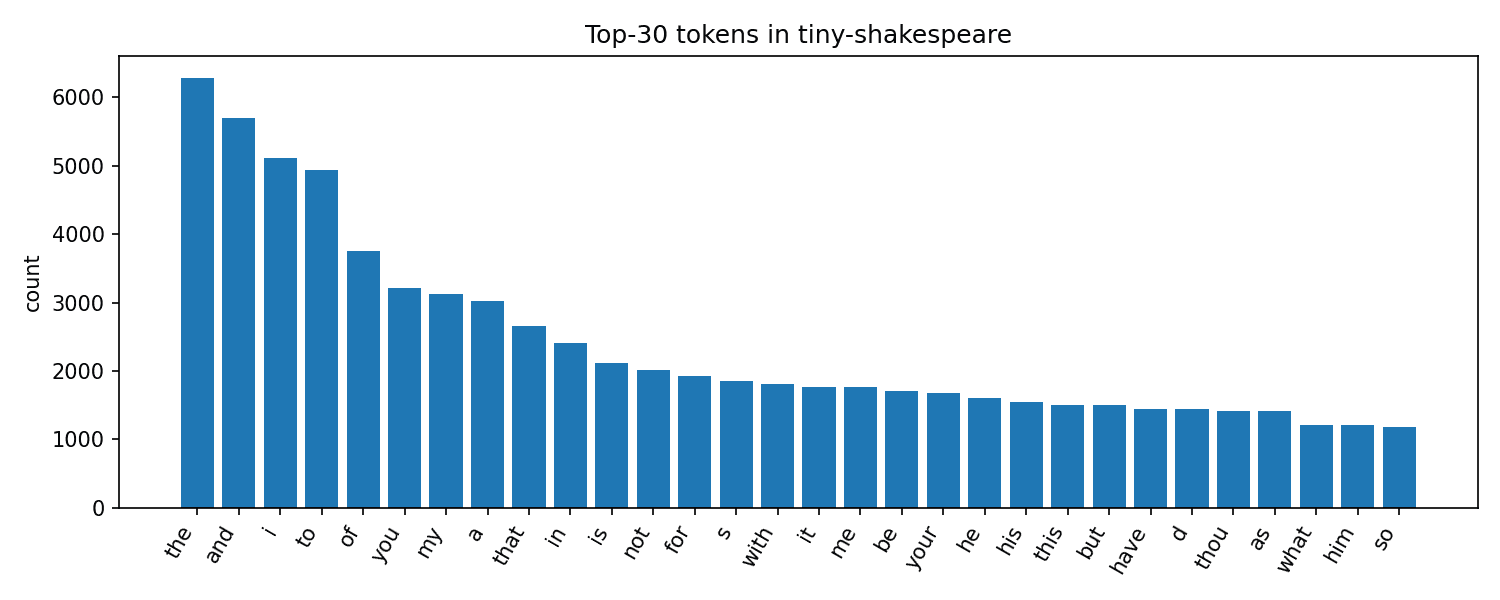
A fixed word-level vocabulary has to draw a line somewhere in that tail - everything past
the line is <|unk|>. And because the tail never stops growing, a bigger corpus just adds
more rare words rather than closing the gap. This is the structural reason word-level
vocabularies get large and still miss words. It is not a quirk of Shakespeare: it is
exactly the rare-word problem that motivated subword tokenization for neural machine
translation (Sennrich, Haddow & Birch, 2016).
Where this goes next
None of the four losses above are bugs - they are the honest consequences of representing
text as whole-word ids. The fix is to stop using whole words. Byte-Pair Encoding works
with subword pieces built up from single bytes, so nothing is ever out-of-vocabulary and the
round-trip stays faithful. The next post,
Building BPE from scratch, builds it from scratch - paste
the same sentence into its playground and watch the <|unk|> disappear.
For more on tokenization beyond these two posts, the Hugging Face NLP Course, Ch. 6 is a thorough, approachable reference.